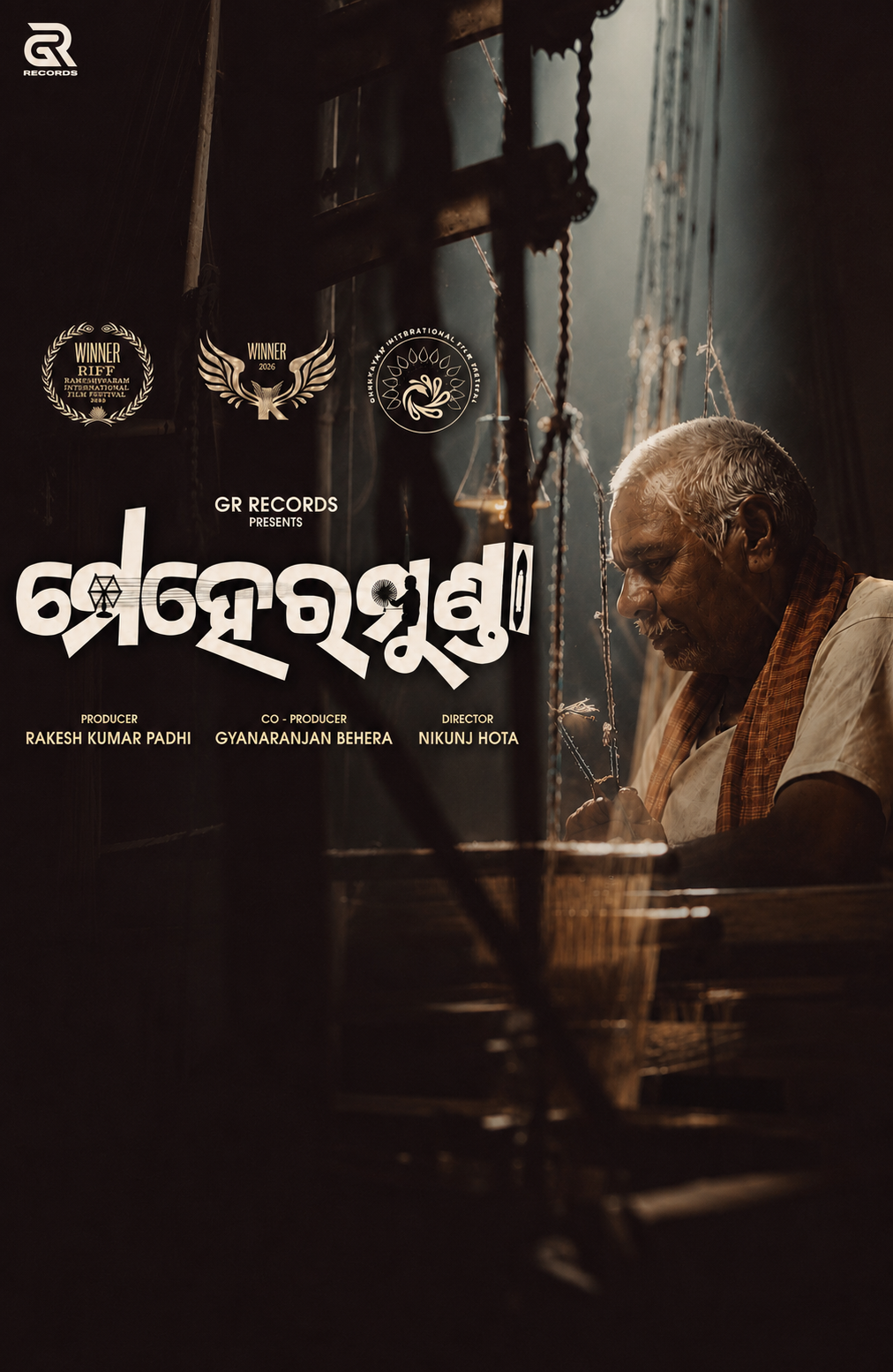
Mehermunda is a sincere and culturally rooted Odia film that brings the struggle and resilience of Odisha’s weaving community to the big screen. Directed by Nikunja Hota, the film tells the story of a traditional handloom village fighting for survival in a post pandemic era through determination, innovation and community spirit.
Story Line
Mehermunda is set in a traditional weaving village of western Odisha, where generations of artisans have preserved the rich heritage of handloom weaving. The story revolves around Kamala Kanta Meher a young weaver who struggles to keep his family’s age old craft alive in face of economic hardship and changing market demands.
The Covid-19 pandemic worsens the situation, leaving the villager’s weaving community on the brink of collapse. As orders disappear and livelihoods are threatened, Kamala Kant with some of his villagers and friend Arjun embark on a journey to revive their community by using online marketing and innovative business ideas.
Direction
Director Nikunja Hota had tried beautifully portraying the life and struggle of Odisha’s weaving community. But at mean time if he could have kept some effort on scene making and other things then it would have come well.
Cinematography
The cinematography by Shrikant Pattnaik had no doubt effectively supported the narrative of the film. But at some part it lacks visual dynamism. In some frames you have tried taking shorts using natural lights, but had failed. And those narratives divide the frames into two tones, also that has not been adjusted during editing and colour grading. A more inventive visual approach could have been elevated for impactful moments.
Screenplay
The screenplay of Mehermunda by Suraj Mohapatra and Nikunja Hota is built around a character driven narrative that blends social and emotional storytelling. Instead of relying on commercial theme, it gradually develops the conflict faced by Odisha’s weaving community after pandemic. The screenplay integrates tradition, friendship and digital transformation giving the film emotional depth and a clear narrative progression. But still I found some areas where it could have been worked better. Like the central conflict is emotionally compelling but could have been intensified to create greater dramatic tension. And the ending is hopeful but felt slightly rushed with some emotional threads resolving too quickly. Some plot developments follows familiar social drama conventions that reduces the surprising matter. Despite these the screenplay succeeds in portraying the struggles of Odisha’s weaving community with honesty and sensitivity.
Dialogue
When you were showing someone’s emotion, their struggle and hardship then there should be impactful dialogues. But here Suraj Mohapatra had worked but not that hard. The dialogues in this film were good but not that impactful which can drew viewer’s attention.
Music
The music by Amit Yuvraaj and Chandraniv Saha might not be commercially chart topping but it effectively supports the film’s emotional and social narrative.
And the background score of Mehermunda composed by Bunny Mohanty and Abhishek Panigrahi lacks a signature leitmotif that audiences can remember forever.
Art Direction
Art direction shapes the visual identity of a film by designing sets, locations, props and overall aesthetics. It creates the story’s atmosphere, reflects character’s emotions and time period. This also strengthens narrative authenticity and enhance the audience’s emotional connection by making the cinematic world believable and visually memorable. In this Prakash Pradhan’s team had created an authentic rural atmosphere through realistic locations and carefully chosen props.
Performance
Jyote Ranjan as Kamala is consistently good but lacks a defining scene that leaves a lasting impression. Yes he has been groomed well than that of his earlier film like Dotpen, but still has to work more on himself like what Sambeet had done.
Arlin Ankita as Pinki might have shared short screen time but has blended in the scene well by avoiding unnecessary melodrama. Her interactions with Jyote feel genuine and help to establish the emotional foundation of the story. Where at some places the emotional dialogues could have been delivered with greater vocal variation.
Susant Dashmohapatra as Saroj has delivers a dependable supporting performance in this film. He has brought maturity and credibility to his role. He expresses emotions through subtle facial expressions and measured reactions instead of exaggeration.
Rakesh Kumar Padhi as Arjun who was also producer of this film had performed well. But the performance remains fairly consistent and could have shown greater emotional variation in pivotal scenes. Because at some emotional scene he was losing his grip. He was good but to be best he has to work more.
Santu Nije as Chandan has acted genuine rather exaggerated. Although his natural acting style and strong screen presence make his character relatable, but the screenplay limits his opportunity to leave a deeper impact on viewers.
Without supporting characters a film was meaningless. So in this the supporting cast Gadadhar Barik, Mita Chakraborty, Prabhakar Mishra, Bijay Kumar Patra and Kamal Lochan Rout had contributed naturally, enhancing the film’s realism.
Next comes the strength and flaws in the Movie
It’s good that the story address issues rooted in rural life, traditional identity and changing social realities, encouraging reflection of society instead of offering easy answer.
With good story the film captures the social environment of rural Odisha without excessive romanticization.
Flaws were like story of weavers has been shown, but could have enhanced it more by showing more work process.
Several sequences linger longer than necessary that stretched first half of the story.
Some conversations are functional rather than memorable and do not consistently reveal deeper character psychology.
There were some shots that were not necessary, like some of low angle shorts.
Overall Verdict
Mehermunda is a meaningful and heartfelt addition to contemporary Odia cinema, showing how tradition and modernity can work together to create a brighter future for artisans and their craft. This film may not offer commercial spectacle, but has an emotional resonant drama that celebrates heritage perseverance and hope.